The implementation of the STAF in the cantons of Eastern Switzerland - selected topics of profit and capital taxation
The eastern Swiss cantons of St. Gallen (SG), Thurgau (TG), Appenzell Ausserrhoden (AR) and Appenzell Innerrhoden (AI) have implemented a number of changes in the taxation of profits and capital as part of the STAF as of 1 January 2020. The present article examines individual voluntary measures and measures not harmonized in the STAF. The analysis focuses on the adjustments in profit tax rates and capital tax, past and future tax relief, the additional deduction for research and development expenses, and a selection of special practical features.
Implementation of the STAF in the Canton of Zurich
Although the Canton of Zurich dealt with the implementation of the Federal Law on Tax Reform and OASI Financing ("STAF") at an early stage and issued various practice notes, various implementation issues still arose in the months following its entry into force. This article deals with the current implementation practice of STAF in the Canton of Zurich, with a focus on the change of status and deductions for self-financing. The practical application of the patent box and the research and development deduction is still subject to announcements by the Zurich tax office.
Implementation of the STAF in the Canton of Ticino
On 1 January 2020, the Federal Act on Tax Reform and Financing of the OASI (STAF) (Riforma fiscale e finanziamento dell'AVS, RFFA) entered into force. Among other things, the federal law modified certain provisions of the Federal Direct Tax Act (DBG) and the Direct Tax Harmonisation Act (StHG). In doing so, the Confederation leaves the cantons some leeway in implementing the STAF in their own tax legislation. This article analyses the implementation of the STAF by the Canton of Ticino.
Implementation of the Federal Law on Tax Reform and OASI Financing (STAF) in the Canton of Berne
Based on the Corporate Tax Reform Act III (USR III) passed by the Federal Parliament on 17 June 2016, the Berne Cantonal Government Council expressed its views on the content of USR III at the end of November 2016, as well as the possible effects on the Canton of Berne and the preliminary positioning of the Canton of Berne in intercantonal tax competition. In the interests of Berne as a business location, the Government Council intended to cushion the abolition of cantonal tax privileges and the associated transition to ordinary taxation with replacement measures as part of the revision of the tax law in 2019. It was planned to reduce the maximum tax burden on profits from 21.64% in two steps; namely to 20.20% in 2019 and then to 18.71% in 2020. Further reductions in the profit tax rate should then have taken place with the 2021 tax law revision. In addition, the 2019 tax law revision also provided for the reduction of the applicable capital tax rate.
Compensation paid by Swiss companies to foreign directors
This video provides information on the possible tax and social security implications of a board of directors resident in an EU country in the case of a Swiss company limited by shares if the board of directors is also self-employed in its country of residence.
Federal Council approves coronavirus package of measures
At its meeting on 20 March 2020, the Federal Council approved various measures to cushion the economic consequences of the coronavirus. The tax measures are as follows:
OECD publishes report on transfer prices in financial transactions
On 11 February 2020, the Organisation for Economic Cooperation and Development (OECD) published a report containing guidelines on the transfer pricing aspects of financial transactions.
Circular letter 34 of the Swiss Tax Conference (SSK)
On 15 January 2020, the Swiss Tax Conference (SSK) published Circular Letter 34 on the "Intercantonal tax separation of companies claiming the deductions provided for in the STAF" for the additional deductions newly introduced for state and municipal taxes - but not for direct federal taxes - following the entry into force (1 January 2020) of the Federal Law on Tax Reform and OASI Financing (STAF) of 28 September 2018.
Tax-deductible interest rates 2020 for advances or loans in Swiss francs and foreign currencies
The granting of interest-free or insufficiently interest-bearing advances or loans to participants or third parties related to them constitutes a payment in kind. This shall also apply to translated interest which is paid on the basis of obligations to participants or third parties close to them.
FTA publishes Circular Letters 22a and 23a concerning the partial taxation of income from investments held as private and business assets
On 31 January 2020, the Federal Tax Administration (FTA) published Circular Letters No. 22a "Partial Taxation of Income from Participations as Part of Private Assets and Restriction of Debt Interest Deduction" and No. 23a "Partial Taxation of Income from Participations as Part of Business Assets and Participations Declared as Business Assets".
OECD publishes statement on taxation of multinational companies
On 31 January 2020, the Organisation for Economic Cooperation and Development (OECD) published a statement on taxation of multinational (digital) companies, according to which an agreement should be in place by the end of 2020 (see also taxlawblog contributions of 12 October 2019 and 9 November 2019).


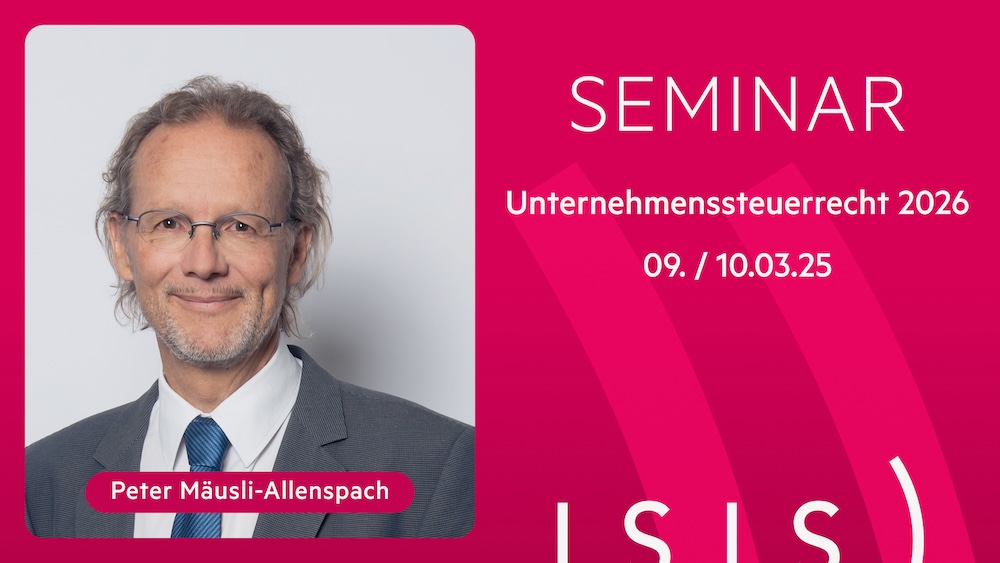
ISIS) seminar folder "Corporate Tax Law (2025)"
All documents from the ISIS) seminar "Corporate Tax Law 2025" from June 02 + 03, 2025 under the direction of Peter Mäusli-Allenspach in one PDF document. Case studies, detailed solution notes and slides: Here you will find all documents of the individual workshops according to the following content description.
Transfer pricing documentation - International and Switzerland (2025)
Workshop by Ivo Manatschal, Simona Studer and Thomas Hug on the occasion of the ISIS) seminar on June 02 + 03, 2025 with the title "Transfer pricing documentation - International and Switzerland"


